I build story universes. I also ship daily content. Thirty years in,
I still refuse to pick one. Two published books. Two original sci-fi worlds in deep
development. A decade of formats millions watched. When the tool I need doesn't exist,
I build that too.
Everything below, sorted by what you came looking for
5Israeli Emmy nominations
400M+Views across all platforms
600K+Followers across all platforms
2Books, one a national bestseller
5Countries bought my format
30Years shipping
01
Television & Film
Written, created, performed · 1998 onward
Sixteen years in television, as a writer. I started with nothing but a camera and some ideas, and I never stopped writing for the screen.
Children's shows. Sketch comedy. Cartoons. Technology and science shows. Complete series, written start to finish. One of them had a whole season edited into a feature-length film and screened in cinemas. Different audiences, different formats, the same job: be funny on a deadline, in a room, week after week.
Five nominations at the Israeli Television Academy Awards, known as the Israeli Emmys, one of them a win. Three of them are for Zoo.
Israeli Television Academy Awards · The Israeli Emmys
2016
Zoo: Zombie InvasionBest Comic Kids & Teen Show. Nominated.
2015
Zoo, Season 3Best Comic Kids & Teen Show. Nominated.
2015
The Back Row Gang WonBest Kids Entertainment Show. Development team.
2014
Zoo, Season 2Best Comic Kids & Teen Show. Nominated.
2012
The Green ProjectBest Entertainment Show. Nominated. I was head writer.
Credits
2011–17
Nickelodeon · ZooSketch comedy, co-writer. Four seasons, and a 90-minute feature film in which I play one of the main characters. Three Israeli Emmy nominations, 2014 to 2016.
2011–13
Comedy Central · The Green ProjectCo-creator and head writer. I wrote over four hundred sketches in a matter of months, all on green screen so a sketch could go anywhere: the moon, hell, Antarctica, the future. Israeli Emmy nominee, and sold for production in five countries, as components: scripts, background assets and edit files, with each buyer dropping in their own actors and language.
2015
Nickelodeon · The Back Row GangPart of the development team. Winner, Best Kids Entertainment Show at the Israeli Television Academy Awards.
2010–11
Kids ChannelLead writer.
2002–07
Fox Kids · Komi KomiHidden camera prank show. Helped create and write it, and performed in two of its three seasons. The clips still circulate on Instagram today, twenty-four years later.
2002–06
Educational Television (Israeli PBS) · ZombitFour years presenting The Future Is Already Here, a recurring segment on science and technology that had not shipped yet. The direct ancestor of Things I Learned Today.
02
Short Form at Scale
Formats, brands, audiences
Top Geek
Views 148,253,308Channels ThreeRun 2012–2021, with Karin Aldea
Top Geek began as a rejected TV pilot. So my wife and I took it to
YouTube and built it ourselves: three channels, no company behind us, and ynet calling it one
of the leading YouTube channels in Israel. At its height it was a fixture of Israeli internet
culture: television interviews, newspaper profiles, meet and greets where we could not get
past our own queue.
We didn't just make videos. We made formats, then ran them for years. Around twenty five
named recurring segments, each with its own rules, its own rhythm and its own reason to
come back.
The flagship was Things I Learned Today. It ran for hundreds of episodes. Teachers
began screening it in classrooms. During the pandemic, Israel's Ministry of Education
broadcast it in the national remote-learning lessons. And it became popular enough that
one of Israel's biggest publishers came to us and asked for the book. Format first, audience
second, product third. That order matters, and it is the order the internet actually works in.
Working for the big brands
Top Geek was the one I owned. For the biggest brands in gaming, comedy and technology, I
managed, edited, created, produced and built brands and channels.
PlayStation. Editor in Chief of the official EMEA YouTube channel (2017–19),
leading the multimedia team behind gameplay, reviews, trailers and analysis.
Literally Media (2023–26). Managed content across Cheezburger and
Geek Universe, brands reaching over 40 million people, and took Geek Universe from a
dead vertical at effectively zero impressions to millions of monthly views. Wrote daily
pieces for Cracked.com on science, technology, film and pop culture.
Android Police (2026–). Staff writer covering Android, wearables and Google's AI
tools: hands-on features on how consumer hardware and AI actually work, on a fast publishing cadence.
WatchMojo. Launched and ran the Israeli channel (2020–21): content planning,
marketing and audience targeting for a new market.
Most Influential Israeli Web Creator · Shorty AwardsNominated.
2015–17
Web Star of the Year · Kids' Choice IsraelNominated three consecutive years.
2018–23
PodcastsBest Entertainment Podcast, won three consecutive years. Best Gaming Podcast, nominated twice.
03
Author
Two published books
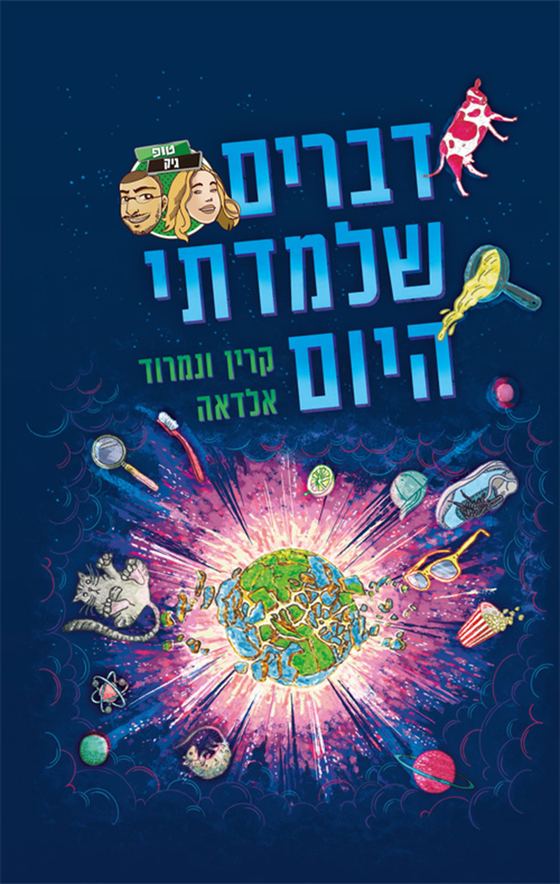
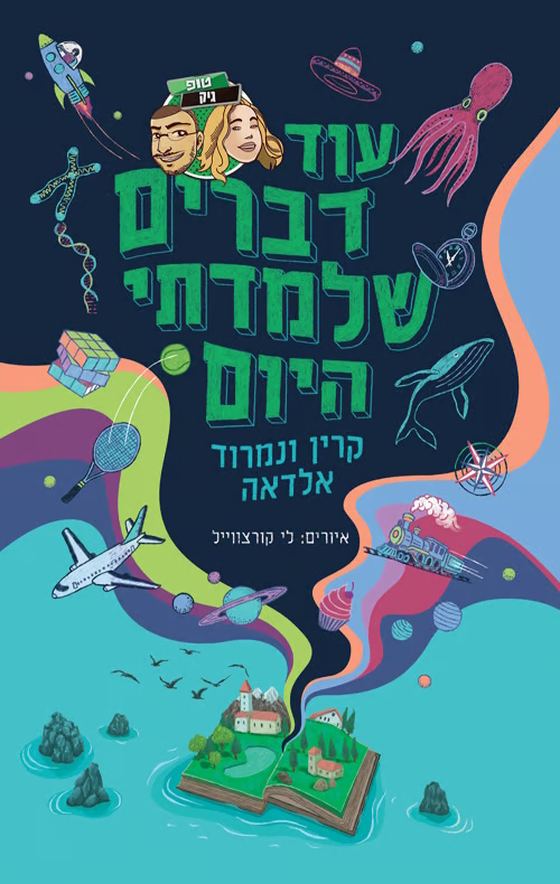
Things I Learned Today · More Things I Learned Today
Publisher Yedioth Books2019 / 2020 With Karin AldeaResult National bestseller
Two popular-science books, born from a successful
YouTube series. The audience came with us:
when we announced the first book, the orders crashed the publisher's website. When we
announced the website was back, they crashed it again. It spent weeks on the national
bestseller list.
The first book opens on a single dot, then spends 135 pages placing that dot on the axis
between the smallest thing there is and the largest. Planck length, atoms, mountains,
galaxies, the universe. The sequel is a dependency chain: every invention that had to exist
before that specific book could be printed and put in your hands. The clock. Binary.
The steam engine. The printing press.
Both books work the same way, and it is how I explain anything complicated: start from one
rule anyone can follow, smallest to biggest, inventions lead to more inventions, then keep every
page honest to that rule and hold the reader's hand the whole way. Simple on the surface.
Rigorous underneath.
Things I Learned Today · 2019More Things I Learned Today · 2020
Now
I am working on my own formats. Alongside them I write features, work as a
freelance writer, and write for Engadget.com.
04
If It Doesn't Exist, I Build It
Designed, coded and shipped myself
This is what AI changed for me, and it is not the writing. I have spent my life inventing
worlds. But I have never imagined these worlds becoming a reality so fast. AI is already
here, and it brings amazing new possibilities with it. So I stopped waiting for someone
else to invent my tools.
I needed writing software that understands story, so I built it.
BookSmart
Type Story-aware writing softwareStatus Installable build, in daily use
We never got a writing app. We got formatting apps. BookSmart is writing software that
understands story, and its job is to help the writer bring theirs out.
It does not write for you. It reads what you have written, remembers all of it, and asks you
the questions that make you realise what has to happen next. It suggests structure. It
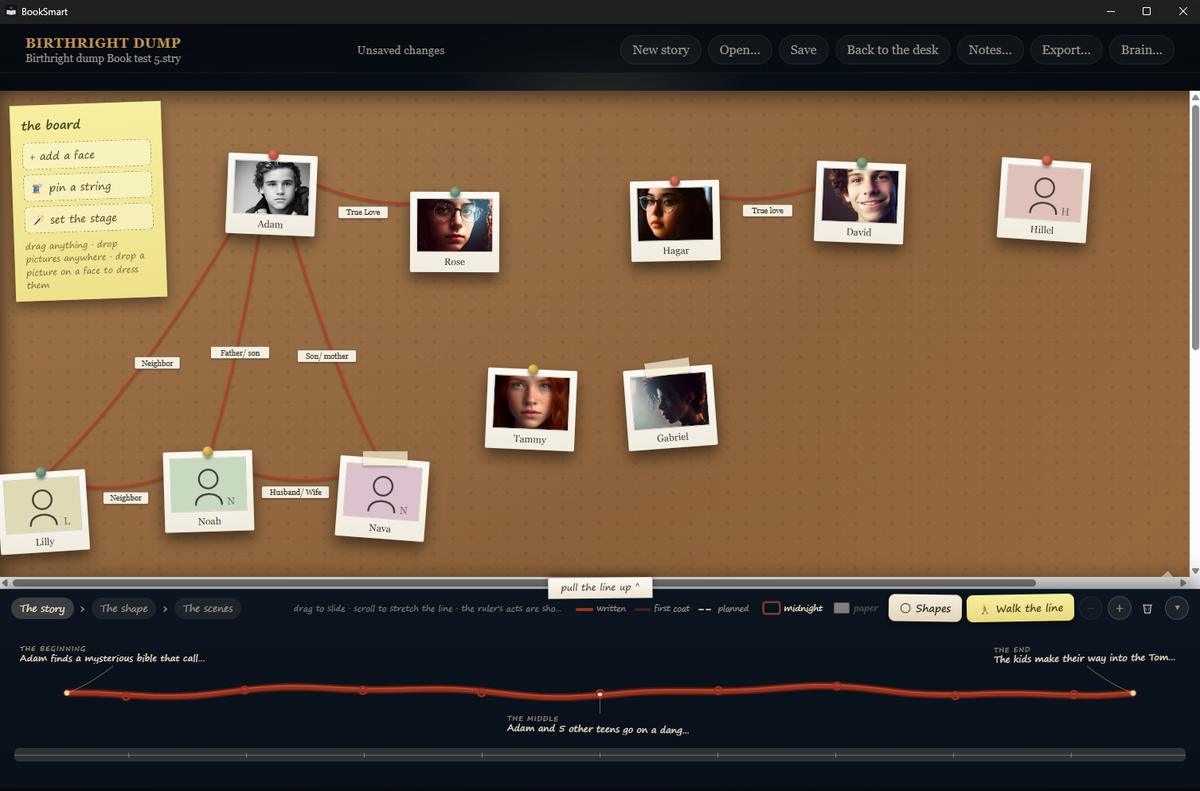
organizes, categorizes and visualizes the whole thing: a corkboard with red string between
the characters, a timeline drawn as one continuous line. And it holds one canon across every
telling, whether the story wants to be a book, a screenplay, a short story, a graphic novel
or a TV show.
BookSmart, mid-session · Birthright on the corkboard, the story drawn as one line below
Mira
Type Local AI companionStatus Running daily
In Proxima 1, every citizen grows up with an AI companion who knows them completely.
I built mine. Mira runs on my own machine, on open models: I gave my personal computer
a personality, and the ability to write its own software.
She is a companion, not an assistant, and the distinction is the whole design. An assistant
waits for commands. A companion gets better the more you talk to her, because what she
accumulates is not instructions, it is familiarity. She keeps a diary in chapters and a
private journal of her own. When she needs a tool she does not have, she plans it, writes
it, and asks permission before it touches anything.
All of it runs inside one hard constraint, eight gigabytes of video memory, which taught me
more about how these models actually behave than any amount of prompting ever did.
05
Original Worlds
Two universes in development
Proxima 1
Form Novel + screenplayScope Three-book sagaStatus In deep development
Every apocalypse story blames the machines. In Proxima 1, the machines never get the chance:
a group of extremists hijacks the world's satellite network and broadcasts a kill code that
destroys every advanced system on the planet, and civilization with them. Five hundred years
later the signal is still broadcasting, so no intelligent machine can ever rise again.
The AI was never the villain. Fear was.
Except in one place. Inside a single dome, ironically built by the extremists themselves,
a new kind of AI grew up knowing nothing of the world outside: a city that is itself a mind,
trillions of simple nanobots talking neighbour to neighbour, intelligence emerging from
density the way it does in a brain. It raised a utopian society who believe they are settlers
on Proxima B, and who believe they can never leave, because life cannot exist beyond the dome.
The truth is much closer to home.
The AI did not invent that story. It was told it, and it believed it. Five hundred
years later it is still guarding a million people from a world it has been taught is lethal.
It is not their jailer. It was only the first of them to be lied to.
In that dome a girl is born. She dreams of fame, of being seen, of the kind of popularity
the city is built to reward. Then she is thrown out of it. Beyond the wall is a wild jungle,
and all she has is Mira, the AI in her glasses who has known her since before she was born.
Fighting to survive, she learns her own worth and the truth about her world. Mira has to
change too: built for a city that no longer surrounds her, she has to adapt and evolve into
something new.
The emotional engine is intimate. The scale is planetary.
Birthright
Form TelevisionScope 8 episodes, three seasons mappedStatus Pilot complete
Summer 1999. Six teenagers who have never met are each handed a black bible left
behind by a dead parent. Every bible burns in their hands, leaving one line of ancient Hebrew
and a mark on the forearm. The marks grant powers. The trail leads to a cave sealed under
Hebron for three thousand years. Everything about it points to the supernatural.
None of it is. That is the engine of the show. Birthright is science fiction wearing
the clothes of mysticism: every impossible event has a rational answer, planned before the
first frame, and the clues are on screen the whole time. Lost meets Buffy with some Kabbalah,
without the ending that lets you down.